Books to be published in the next two months
BOOKS THAT ARE IN BOTH THE
"HOWARD CHANDLER CHRISTY ART BOOK COLLECTION"
AND THE
"LONGFELLOW LITERATURE + ART + CONTEXT COLLECTION"

Henry Wadsworth Longfellow (1807 -1882) published the first edition of this epic poem (def: a long narrative poem in elevated style recounting the deeds of a legendary or historical hero) in 1858; Bobbs Merrill published the edition illustrated by Howard Chandler Christy (1872 - 1952) in 1903. The poem is about a love triangle between Captain Miles Standish, John Alden and Priscilla Mullins; both Miles and John compete for Priscilla's affection and hand in marriage. In the end, John becomes Priscilla's husband. ...all of this being historic fact or legendary story. Longfellow was drawn to the history or legend of these three, because John and Priscilla are his fifth great grandparents. Of course, Longfellow and Christy never met each other; Longfellow died when Christy was 10 years old. Christy was attracted to this story because Miles, John and Priscilla were all among his 7th great parents (one of Miles' sons married one of John and Priscilla's daughter. Likely unknown to Christy was Longfellow and him were cousins to each other!

Christy's biography trilogy "An Affair with Beauty, The Mystique of Howard Chandler Christy" by James Philip Head, in its first volume "The Magic of Youth" relates that Longfellow's epic poem "Evangeline - A Tale of Acadie" was one of his favorites, Christy said, "Someday, I want bring them to life. Maybe I will" ...and that Christy did, in 1905, when Bobbs Merrill published Christy's amazing illustrations in "Evangeline". Certainly, many artists illustrated versions of "Evangeline", but Christy's version is among the best, perhaps the best, depending on the viewer's perspestive.
BOOKS THAT ARE IN THE
"HOWARD CHANDLER CHRISTY ART BOOK COLLECTION"
Howard Chandler Christy (1872 - 1952) has never had a published retrospective of his many art forms; Little Paris Art has laid out a series of 14 volumes to represent his first series of retrospective books. LPA will first publish three different themes and types shown below.
Mr. Christy was known to the general public for his "Christy Girl" illustrations; however, there is so much more to his artworks. More on the Christy Girl later. He was raised in a rural part of Ohio, not too far from Zanesville, and showed artistic talent at an early age. Through scraping up the financial resources, he was able to study at New York City's famous Art Student League, followed by close tutelage with William Merritt Chase (1849 1916), who was well known for his portrait paintings. Chase was disappointed to eventually here that Christy - inspired by the illustrative work of Charles Dana Gibson (1867 - 1944) - that he chose commercial illustration over portrait paintings. Gibson was already famous for his beautiful "Gibson Girls", their romances, and satirical drawings. Then Gibson, Christy and many other talented illustrators served as war correspondents for Spanish American War. Christy, with a very quick hand at drawing, depicted over 400 subjects and scenes from the War. This earned him much acclaim to the point that he earned his first fame. At the end of war, he married Maebell Thompson, quite beautiful, who became the first "Christy Girl". The response from his fans thrust him to even higher fame. He became a celebrity artist, with full page articles about him all around the country. Having Christy's illustrations on the cover or contents of a book or magazine was a sure multiplier of sales. Harrison Fisher followed with his "Fisher Girls" All of Gibson's, Christy's and Fisher's artists "Girls" supported a new vision of American women from that of the Victorian Era. These women were more independent, self-confidence, escaped from the housework to explore new pastimes in outdoor sports, arts and culture, with less conservative clothing. The next war, World War I, saw all three to volunteer making "propaganda" posters about all aspects of the war. James Montgomery Flagg scored the most famous poster of the war - Uncle Sam's I Want You. Christy's use of Christy Girls as the subject of perhaps all of his posters; this appeared unconventional for an all-men military, but proved very effective. His most famous poster as "Gee, I Wish I was a Man so that I could join the Navy", which depicted a Christy Girl in an oversized male soldier's uniform. After Christy's and Maebelle's prolonged and nasty divorce, he married Nancy Mae Thompson Palmer. After World War I, she convinced him that he should paint more. Though he still drew illustrations, which was a steady money draw, he once again drew fame for his portrait paintings of many mostly famous or rich subjects and mammoth murals, mostly of historical events, but one set of nudes at New York City's Cafe des Artistes, the restaurant on the ground floor of the apartment where he lived and had his studio. There is so much more, but as the various retrospective artbook series' volumes are launch, you see the numerous facets of Christy's artist talent!

Howard Chandler Christy (1872 - 1952) was known for his "Christy Girl" illustrators, Charles Dana Gibson was his inspiration to initially dedicating himself to illustration with his "Gibson Girls", Harrison Fisher followed with his "Fisher Girls" All of these artists supported a new vision of American women from that of the Victorian Era. These women were more independent, self-confidence, escaped from the housework to explore new pastimes in outdoor sports, arts and culture, with less conservative clothing. The four books whose illustrations are presented in this book are specifically focused on The Christy Girl.

Mr. Christy had two "Drawings" books, one in black & white and the other with some color drawings, as well. Most of the Drawings books' illustrations come from other Christy's books, magazines and serials. However, they are presented in much more detail; even if a previous image was in color, the black and white ones here were more brilliant in their beauty.
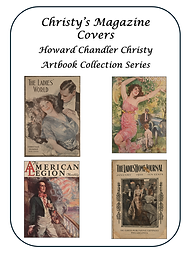
Howard Chandler Christy being very well nationally and respected for his talent was a "sell"; that is, having his illustrations on a magazine or book cover, or there within, helped to sell publications. Mr. Christy had dozens of magazine covers which are all iconic. This volume of the "Howard Chandler Christy Artbook Collection" included so many memorable magazine covers from so many magazines.
BOOKS THAT ARE IN THE
"LONGFELLOW LITERATURE + ART + CONTEXT COLLECTION"
"Evangeline - A Tale of Acadia" was a legend or historical fact {?} about the plight of the Acadians - the mostly French immigrants who lived in what is now Nova Scotia, Prince Edward Island and Newfoundland. These Frenchmen arrived with their families starting in 1605. They lived happily there until the British took absolute rule over Acadia shortly before -starting in 1755 - they forcefully exiled the Acadians. The absolute choice that was "Either swear allegiance to the British Crown or be exiled!" The Acadians were so staunchly Catholics that the thought of worshiping in The Church of England was repulsive to them; hence, the deportation of a large majority of the Acadians. You can say that the British virtually crammed the exiles into ships, with no care for whether they kept families and loved ones together in the same ship. The British randomly shipped the Acadians up and down the Atlantic Coast of what became the USA. Then to France, the Caribbean islands, and some even as far as South America. Almost every site where the exiles settled, they were unwelcome. Hearing this plight, the Spanish who ruled the extremely large Louisiana Territory welcomed the Acadians to come to South Louisiana, which many took advantage of this offer.

A vintage map of Acadia.
The story of how Henry Wadsworth Longfellow heard the story of this strife is very interesting and is included in both books. Specifically, this tale describes how an engaged couple were stranded apart in separate locations. Longfellow named bride-to-be as "Evangeline", who spent her whole life wandering trying to find her love, who the poet named "Gabriel". NO MORE so as to keep the final plot unknown. Henry Wadsworth Longfellow (1807 -1882) first published his epic poem "Evangeline - A Tale of Acadie" in 1947. This edition had no illustrations, but sold six printings in the first year, a first for his time. This extraordinary sales demand thrust Longfellow to global fame in a short time.

In 1850, a mere three years after the first edition, several well-illustrated versions were printed in the U.S. and England alone. This edition had 45 woodblock print images and was published by David Bogue of London, England. Sir John Gilbert (1817- 1897) - was one the most revered artists from England ... and two of his compatriots: Myles Birkett Foster (1825 - 1899) and Jane Eleanor Benham-Hay ( 1829 - 1904). Gilbert had much skills in so many art forms, but may be best known for his illustrations of Shakespeare, one three-volume set alone had over 800 illustrations. Foster was particularly know for his watercolors and for his illustrations of many countries in Europe. For Benham-Hayes, she had broken many glass ceilings for women artists of her time. Though she was denied admission to a prestigious Munich art school, she obtained a virtually equivalent education by having a studio there and benefiting from many of the master artists there. This 1850 book most probably her first, amazingly with two much more established and esteemed artists. Her images reflect deep emotions of kindness and love. This reprint of the original 1850 book was printed with woodblock printing of the images; this printing method goes back to ancient Egypt and was displaced by offset printing about 1900. Using woodblock printing meant that a fourth set of artists - the woodblock engravers - in this book, one of the most famous and respected - Henry Vizetelly, printer and engraver. His company translated the pen and ink drawings of Gilbert, Foster and Benham-Hay on the woodblock - IN REVERSE, so that it would print properly. Without the Vizetelly's expert work, the book would not have exhibited so much quality.

Léon Pamphile Lemay (1837 - 1918) was from Québec and was noted as the best Canadian-French translation of Longfellow's Evangeline. Because the Acadians, about which Longfellow's poem was written, lived in the French speaking provinces of Nova Scotia, Prince Edward Island and Newfoundland beginning in 1605, that his version is in Candian-French is entirely appropriate. His 1865 version was critiqued by Longfellow himself in the book, which evidently motivated to produce an 1870 version with improved translation; and, finally, a 1912 version with still-improved translation. Of course, the 1912 was the obvious choice for this 2026 version. None of Lemay's three editions were illustrated, so Little Paris Art chose Sir John Gilbert's woodblock illustrations from his 1856 edition.
Get on the List
Sign up to receive the first word about when new books are available to order ...and much more.


